Search This Blog

Showing posts sorted by relevance for query House Finch. Sort by date Show all posts

Tuesday, January 19, 2021

N'tl Bird Day 2021 has come and gone! However, one can continue to celebrate! (Tuesday's Truths WK 201)

This image features a male House finch perched on the left side of a bird feeder that is shaped like house. The feeder is made of metal and is hunter-green in color. House finches are featured in volume one of my book series, "Words In Our Beak."  Info re these books is in another post on my blog @ https://www.thelastleafgardener.com/2018/10/one-sheet-book-series-info.html
MALE HOUSE FINCHES ARE FEATURED IN WIOB

This two hundred and one segement of Tuesday's Truths is to alert you to the fact that National Bird Day has come and gone for the year 2021. It was celebrated three weeks ago on 1-5. Information re this holiday can be found in a number of places on the web including a page for National Day

In bygone years, I've published posts about this occasion as I certainly appreciate any occasion that aims to raise awareness about members of the animal kingdom and I don’t think it needs to be limited to one day.

But this segement is also designed to let you know that if you missed this year’s National Bird Day, just make it a point to do something that will benefit our feathered friends, such as making sure any bird feeder you have is clean as well as replenished. 

They will truly appreciate your efforts as evidenced by this male house finch (in the photograph directly above) who is enjoying a snack from a feeder in my garden.

Another thing you can do is to make sure your bird bath is clean and if winter temperatures are prevailing, make sure the water isn't frozen.

Thursday, May 29, 2025

TEST YOUR POWERS OF OBSERVATION

Be sure to take note of the male House sparrow who is alighting on a branch belonging to my Contorted Hazel Nut as he peeks around the black utility pole. In close proximity there is a male Northern cardinal (a bird type that has bright red coloring) whose beak is slightly open. He is perched on a black bracket that supports one of my bird feeders that looks like the type of a house-shaped trinket used in the board game Monopoly, only it's much larger because it is not a game board trinket, it is a bird feeder. There is a bird at the back of the feeder whose tail is the only feature that is visible. A Mourning dove is sitting atop the feeder and the creature appears to be staring at another male House finch who is perched on the right hand side of the feeder.
Male House sparrow, Male Northern cardinal, Mourning dove & Male House finch

Be sure to take note of the male House sparrow who is alighting on a branch belonging to my Contorted Hazel Nut, his back is to the black utility pole and he seems be looking at something that's on a nearby branch. In close proximity, a male Northern cardinal (a bird that type has bright red coloring) whose foot is wrapped around a black bracket that supports one of my bird feeders that looks like the green-colored houses that resembles those in the game Monopoly. However, it is much larger than the game's trinket because, After all, it's a bird feeder. A Mourning dove is sitting atop the feeder and his/her eyes are closed which makes his/her "signature" feature of pale blue-colored eyelids) apparent. A male House finch is perched on the right hand side of the feeder.
Male House sparrow, Male Northern cardinal, Mourning dove, Male House finch

Be sure to take note of the male House finch who is alighting on a branch belonging to my Contorted Hazel Nut. He seems to be gazing beyond the close by utility pole. The picture also features a male Northern cardinal He is p (a bird type whose coloring is bright red) perched on a bracket that supports one of my bird feeders and his crest is raised ever so slightly, albeit a bit higher than in the previous image.  A Mourning dove  is sitting atop the feeder and the creature appears to be staring into the window of the building across the courtyard. There is another Mourning dove dining at the feeder, you can see his feet below it and you might also note that one of his/her wings is in motion.
Male House finch, Male Northern cardinal, Mourning doves

Be sure to take note of the male House finch who is alighting on a branch belonging to my Contorted Hazel Nut. He seems to be gazing beyond the nearby utility pole. The picture also features a male Northern cardinal (a bird type who has bright red coloring). He is perched on a black bracket that supports one of this bird feeders and his crest is raised ever so slightly, albeit a bit higher than in the previous image. The feeder is shaped like a house and has green coloring. A Mourning dove is sitting atop the feeder and the creature appears to be staring into the window of the building across the courtyard. There is another Mourning dove dining at the feeder, you can see his feet below it and you might also note that one of his/her wings is in motion.
Male House finch, Male Northern cardinal, Mourning doves

Be sure to take note of the male House finch who is alighting on a branch belonging to my Contorted Hazel Nut. He seems to be gazing beyond the nearby utility pole. The picture also features a nearby male Northern cardinal (a bird type who has bright red coloring). He is perched on a black bracket that supports a bird feeder. His crest is raised ever so slightly. The feeder is shaped like a house and has green coloring. A Mourning dove is sitting atop the feeder and the creature appears to be staring into the window of the building across the courtyard. There is another Mourning dove dining at the feeder, you can see his feet below it and you might also note that one of his/her wings is in motion
Male House finches, Male Northern cardinal, Mourning dove

Be sure to take note of the male House finch who is alighting on a branch belonging to my Contorted Hazel Nut. He appears to be watching something beyond the garden's area.  The picture also features a male Northern cardinal. He is perched on a bracket that supports one of my bird feeders and his crest is  completely lowered as he gazes down at a Mourning dove who is sitting atop the feeder and the creature has his eyes closed showing off his blue eyelids.  Another male House finch is at the front of the feeder (lower right).
Male House finches, Male Northern cardinal, Mourning dove

Be sure to take note of the male House finch who is alighting on a branch belonging to my Contorted Hazel Nut. He appears to be watching the birds who are at the feeder.  The picture also features a Mourning dove who is sitting atop the feeder. and the creature has his eyes closed showing off his blue eyelids.  A portion of a small songbird's wing as well as a portion of his/her tail can be seen at the bottom of the feeder (left) and slightly to the right of the feeder, another House finch flying away from his peers.
Male House finches, Male Northern cardinal, Mourning dove

A few days ago before the days upon days filled with heavy rains were in full force, I took the bird-themed pictures that are included within this post.

There are seven photos within this posting and they all feature a few bird varieties who have been hanging out at one of my feeders, as well as alighting on the branches of my Contorted Hazelnut. It's as if they were having a last hurrah before the onset of relentless downpours occurred.

At first glance these images might look the same to you as their differences are very subtle, can you spot how they differ?

Other bird types are also visiting but they are not included in these pictures.

FYI, all of these bird types are featured (along with many other bird varieties) in my books.

This image features my 3 volume book series, "Words In Our Beak." https://www.thelastleafgardener.com/2018/10/one-sheet-book-series-info.html
This is the cover of my interactive digital book titled "Bird Tales." https://www.thelastleafgardener.com/2018/10/one-sheet-book-series-info.htmlThis is the cover of my interactive digital book titled "IT;S THE LITTLE THINGS." https://www.thelastleafgardener.com/2018/10/one-sheet-book-series-info.html

You can find info re this matter within a post on this blog.

MEANWHILE, I'd like to give a shout out to PC who has been supplying my visiting birds with a variety of seeds. I'm not in the position to get this for them, but fortunately for the avian community, she has been able to this, for she loves observing them from the vantage point of her place and she also appreciates the songs they offer while spending time here.

Saturday, February 29, 2020

Rare Disease Awareness Day 2020

IMAGE CREDIT

Today is Rare Disease Awareness Day and as a way of paying homage to it, I've posted a "promo" image atop this entry.

This annual "holiday" was initially brought to my attention (through a 2018 Facebook posting by my acquaintance (Catherine C) and I blogged about it at time stating:

According to a number of sources, including NORD (The National Association for Rare Disorders), "In the U.S., any disease affecting fewer than 200,000 people is considered rare. This definition comes from the Orphan Drug Act of 1983 and is slightly different from the definition used in Europe. There are more than 7,000 rare diseases affecting 25-30 million Americans. In other words, one in ten Americans are suffering from rare diseases and more than half of them are children."

Monday, December 7, 2020

A Recent Visit

This photo features a male house finch perched on the branches of an Ailanthus tree. A web-page re this bird describes this bird type by saying, “ House Finch males are more orangey-red with color equally bright on crown, throat, and breast. Red color is mostly restricted to head and upper chest, contrasting with cold gray-brown nape, back, and wings. Pale sides show distinct brown streaks, lacking red tones. Females lack bold face pattern and have more diffuse patterning overall. Often sings loudly in neighborhoods and visits feeders.” House finches have a backstory in volume one of my book series, “Words In Our Beak,” where I describe how they were nearly wiped off the Eastern seaboard due to issues with their eyesight. Info re my books is in another post on my blog @  https://www.thelastleafgardener.com/2018/10/one-sheet-book-series-info.html
HOUSE FINCHES HAVE A BACKSTORY IN VOL 1

This photo features a male house finch perched on the branches of an Ailanthus tree. A web-page re this bird describes this bird type by saying, “ House Finch males are more orangey-red with color equally bright on crown, throat, and breast. Red color is mostly restricted to head and upper chest, contrasting with cold gray-brown nape, back, and wings. Pale sides show distinct brown streaks, lacking red tones. Females lack bold face pattern and have more diffuse patterning overall. Often sings loudly in neighborhoods and visits feeders.” House finches have a backstory in volume one of my book series, “Words In Our Beak,” where I describe how they were nearly wiped off the Eastern seaboard due to issues with their eyesight. Info re my books is in another post on my blog @  https://www.thelastleafgardener.com/2018/10/one-sheet-book-series-info.html
HOUSE FINCHES HAVE A BACKSTORY IN VOL 1

This photo features a male house finch perched on the branches of an Ailanthus tree. A web-page re this bird describes this bird type by saying, “ House Finch males are more orangey-red with color equally bright on crown, throat, and breast. Red color is mostly restricted to head and upper chest, contrasting with cold gray-brown nape, back, and wings. Pale sides show distinct brown streaks, lacking red tones. Females lack bold face pattern and have more diffuse patterning overall. Often sings loudly in neighborhoods and visits feeders.” House finches have a backstory in volume one of my book series, “Words In Our Beak,” where I describe how they were nearly wiped off the Eastern seaboard due to issues with their eyesight. Info re my books is in another post on my blog @  https://www.thelastleafgardener.com/2018/10/one-sheet-book-series-info.html
HOUSE FINCHES HAVE A BACKSTORY IN VOL 1

I have only been able to take a couple of walks in my nearby parks since March (2020) because the coating on my lenses of my prescription lenses has worn off and replacing them is out of my financial reach at this time.

Unfortunately since the coating is damaged, my glassses steam up constantly when I wear  a face-mask and I can't see where I am going which is very frightening.

I have tried many "home remedies" to prevent the steaming but because the issue has to do with the coating, my battle is endless.

Moreover, due to the fact that I fell last January (which resulted in my  breaking my Greater tuberosity), I am feeling vulnerable when it comes to the prospect of falling, SOOOO... I have had to stay at home more than I would like to, and I miss the parks!

Therefore, my spirits were lifted the other day when I discovered that a lone male House finch was spening some of his time perching on the branches of Ailanthus trees in the courtyard (as evidenced in the imagess atop this posting).

Thursday, January 17, 2013

"another year over AND a new one just begun . . . " PART TWO-H-2 (Oct 11th — Oct 24th 2012)


Today's entry here on Blogger is part two-H-2 of a series of posts pertaining to a year-end review for special occurrences in my urban garden for the year 2012 (the schedule for this series is described in part one as well as part two-A of this topic) and, as I've said, because October 2012 was the month Hurricane Sandy hit the area near to where I live, my garden went through another upheaval, so I will be posting the review for October in three parts.

Friday, November 16, 2012

Thank God It's Friday (TGIF) AND For Many THINGS


Part of my morning routine is to read Mutts, the comic strip by Patrick McDonnell, a comic strip which I have referred to a number of times here on Blogger, and if you'd like to refer to entries regarding this, please click here

Meanwhile, Mr. McDonell's "episode" from Monday, November 12th, is posted above today's blog entry. I adore all of McDonnell's characters as well as the "stories' of occurrences in their daily lives; but I was particularly touched by the one I'm featuring above today's blog entry due to my appreciation for all the birds which visit my rooftop garden.

As anyone who follows TLLG here on Blogger, tumblr, or Facebook, knows, I have been thrilled by the birds which visit my garden, and I have been saddened whenever Cam (one of my visiting cardinals) disappears for prolonged periods of time. I have posted her picture below for those of you who may be new to TLLG's venues.


Moreover, if you'd like to read "stories" about Cam's antics, you may do so by clicking here for entries that have been published here on Blogger; or here for posts that have been written about her on tumblr. 

Additionally, you may click here to view a Virtual Story (mini movie) which features a number of photo-ops "showcasing" her.

In any event, whenever Cam disappears, my reaction is very much like Mooch's — the cat — in McDonnell's comic strip, I don't wonder if it was something I said; rather, I wonder did I frighten her somehow? Did I leave too much food or not enough? Did I not plant "things" that attract birds? Did I not clean her feeder throughly? And, also, in my saner moments when I realize her absences may have little to do with me, I always worry that she has been injured and that I could've of devised a way to insure her safety. 

My reactions are clearly tied in with my abandonment issues re having a father who left our family when I was quite young and a mother who insisted if I talked to him in the "right way" he'd return, which he never did.

Monday, November 21, 2016

The Inspiration of a Leucistic House Finch AND Vinicio Riva


Yesterday, a female house sparrow and a male house finch were having a conversation while perched on a railing that surrounds my rooftop garden (in NYC), as evidenced in the pictures atop this blog entry, where you can see them sharing the railing with my kiwi vines.

Normally the coloration of male house finches is red, and, knowing this, caused the little sparrow to be very concerned as to what caused this particular finch to have a white-colored face and a white head. The sparrow listened very carefully and with great empathy as the house finch confided in the sparrow saying that he had a case of leucism.

Monday, January 14, 2013

"another year over AND a new one just begun . . . " PART TWO-G-2 (Sept. 12th — Sept. 20th 2012)


Today's entry here on Blogger is part two-G-2 of a series of posts pertaining to a year-end review for special occurrences in my urban garden for the year 2012 (the schedule for this series is described in part one as well as part two-A of this topic) and, because September 2012 was the month when my garden went through so much upheaval, I will be posting the review for that month in two parts. The first part of September (September 1st — September 11th) was discussed in yesterday's post.

In today's entry I will be reviewing events that took place in the month of September during the time period of September 12th through September 20th for the year 2012, and I will begin by referencing the photograph above which illustrates the fact that in spite of the various losses in my garden, my bling wearing (ankle bracelet or a branding bracelet) house finch was continuing to come back to my garden.

Wednesday, January 16, 2013

"another year over AND a new one just begun . . . " PART TWO-H-1 (Oct 1st — Oct 10th 2012)


Today's entry here on Blogger is part two-H-1 of a series of posts pertaining to a year-end review for special occurrences in my urban garden for the year 2012 (the schedule for this series is described in part one as well as part two-A of this topic) and, because October 2012 was the month Hurricane Sandy hit the area near to where I live, my garden went through another upheaval, so I will be posting the review for October in three parts.

Friday, April 12, 2013

THINKING OF STARR SAPHIR

CAM, A FEMALE CARDINAL

If you follow TLLG here on Blogger or Facebook, dear reader, then you know that recently much of my content has dealt with the escapades of Cam (the cardinal pictured in the image above), as well as the tales of her unnamed (as of this posting) beau, pictured in the image below...


MAC, A MALE CARDINAL

...and of their romantic interlude (indicated in the following image).


MAC AND CAM: A CARDINAL COUPLE

I'm thrilled with the aforementioned couple, and could continue to write about them for some time to come, but I am dedicating today's post (through the "escapades" of the array of all the birds which visit my garden) to Starr Saphir, a dearly departed birder, who you may read about by clicking here.

Ms. Saphir was known to many for the bird walks that she led in Central Park. Even though I live very near to this park, I've never been on one of her bird walks; or any other bird "event," for that matter, as my interest in birds as well as their antics, is fairly new: I have the feathered creatures to thank for it because they showed up in my garden without an invitation or lure of food other than the vegetation in my garden!

Monday, March 22, 2021

A Thing or Two re Male House Finches

Upon my seeing the sighting (featured in the image directly above) of a male House sparrow and a male House finch at a bird feeder, I am reminded of something that  I've just read:

 "Among the feeder birds of North America, few are as recognizable and widespread as the House finch and House sparrow. The House sparrow, originally from Europe, is one of the most well-established invasive species in the United States. The House finch, however, is invasive in its own right. Originally native to only the western United States and Mexico, it has spread rapidly through the east since a small number of caged birds were released in New York in 1940."

This reference doesn't give due diligence to the plight of  House finches who were once pegged was "Hollywood Finches" when sold illegally as pets. Plus House finches were nearly wiped off the Eastern seaboard due to a a type of conjunctivitis.

In terms of male House finches, while their coloring is bright red, the colors of the female are  muted giving them a protective camouflage. Deep red coloring in the males of this bird type indicates they are healthy and might make good partners and fathers to their children. Perhaps this is what is on the mind of the female house finch featured in my photograph (titled Dinner for Two) during her date. 

It has been rendered on to a note-card by Fine Art America (AKA FAA).

This is a screen shot of a card which I'm selling on Fine Art America. It features a couple of House finches at a tube shaped bird feeder filled with seeds. The female (brownish) is on  the left side of the feeder while the male (red) is on the right of the tube. Info re this card is @ https://fineartamerica.com/featured/dinner-for-two-patricia-youngquist.html?product=greeting-card
CHECK THIS OUT ON FINE ART AMERICA

By the way, FAA can also render the images on to an array of surfaces for wall art.

Saturday, March 2, 2013

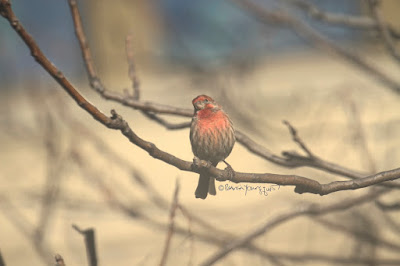
Waiting for Spring

MALE HOUSE FINCH

This is the last "official" weekend of shorter daylight hours! Next Sunday, March the tenth, those of us who are living in the majority of the states in the U.S.A. will set our clocks forward one hour; and from that period on, we will experience longer hours of daylight until November the third of 2013, at which time we will set our clocks back by an hour: in either case proving Kermit to be right for "time is fun when you are having flies."

Thursday, February 28, 2019

Rare Disease Awareness Day 2019


It was brought to my attention (through a Facebook posting) yesterday by my acquaintance (Catherine C) that Rare Disease Day is being observed on February 28th this year.

According to a number of sources, including NORD (The National Association for Rare Disorders), "In the U.S., any disease affecting fewer than 200,000 people is considered rare. This definition comes from the Orphan Drug Act of 1983 and is slightly different from the definition used in Europe. There are more than 7,000 rare diseases affecting 25-30 million Americans. In other words, one in ten Americans are suffering from rare diseases and more than half of them are children."

She advocates for this cause due to the fact daughter has a rare disease (Klippel-Trenaunay Syndrome AKA Fibro-Adipose Vascular Anomaly OR Kawasaki Disease). As it happens, before I saw Catherine's posting, I had a very unpleasant experience re my rare disease (Neurofibromatosis).

Sunday, January 31, 2021

STOP THE SPREAD (of lovers's quarrels)

HOUSE FINCHES ARE FEATURED IN WIOB

The other day was quite cold and I noticed a male House finch puffing up as he perched on a branch within an Ailanthus tree in my courtyard. Puffing up is something birds do to keep warm as I mentioned in this past Friday's posting

Male House finches are red and the females have brownish tones thus they blend in with nature, which is helpful in them being able to protect a nest.

The one seen here (lower left) blends in with the branches so much that I may not have noticed her had I not wondered what the male was looking at. Their distance reminded me of the social distancing, a "task" that folks around the world have been asked to keep to help prevent the spread of the coronavirus.

Sunday, November 22, 2020

Special Time-Sensitive Offer from Fine Art America re my Images


Fine Art America, AKA FAA (the place that does my fulfillment for my art "merchandise"), offer for free shipping ends tonight, November 22nd at midnight EST. 

I have several varieties of greeting cards and a fraction of them can be seen within the images included in my poster which is atop this entry.

Some of my other greeting cards can be seen within the folllowing sequence of photos:

Sunday, December 31, 2017

Let them eat snow!


It is the last day of 2017, and I really should be shredding documents as well as personal letters that are no longer relevant to me, but for now, I'm composing my third entry for this day. In my previous post for today, I mentioned that "it's only the seventh day of Christmas," which means it is the day when someone's true love gave to them seven swans a swimming, six geese a laying, five golden rings, four calling birds, three French hens, two turtle doves, and a partridge in a pear tree.

Now, in honor of the occasion of someone giving their true love seven swans a swimming, I've posted an image of my swan-themed ornament atop this entry. You  might recognize her as she was featured in a 2016 posting here on Blogger.

However, at this time, I don't think they'll be many swans a swimming in many parts of the USA, as it is very cold in a number of parts of this county, so places they'd be swimming are frozen; and NYC, is hardly an exception!

Friday, April 15, 2016

My Malus 'Prairfire' (Prairfire Crabapple)

MY ROOFTOP GARDEN

Ever since I helped rescue Super, a migratory bird who is a Northern Flicker, all of my postings, except for one, have been about that injured bird. It is my intention to visit Super at least once a week until he is able to be released from the bird rehabilitation facility on NYC's Upper Westside to Central Park. I would gladly see him more often, but the facility where Super is recovering is very busy. I don't want to interfere with their efforts to help Super or the other injured birds they are treating.

Meanwhile, I am doing my best to maintain my urban rooftop garden and  keep it a haven for the urban birds who have visited it over the years. My garden can be seen in the photograph atop today's Blogger entry. I took the image from the vantage point of a nearby penthouse garden. The picture was taken in 2015 during the late summer or early fall; and Cam, a cardinal who visited me during that time, insisted we include it in the ePub (Kindle) version of our book Words In Our Beak Volume One.

Wednesday, June 4, 2025

Male House Finch Dines Solo in my Garden

This collage features nine images of a male House finch sitting upon a metal saucer where he is nibbling on seeds. He is  about 6 inches in length and has a square tail. As for his plumage, he is brightly colored; has a reddish-burgundy or red on his head, neck, and upper breast. He has what is known as a a conical bill, well-suited for cracking seeds.

I came across these pictures I took of an adorable male House finch who was dining solo and al fresco in my garden.

Given my new NF (Neurofibromatosis) symptom that I spoke about in a posting on FB, I am especially thankful that I can find joy in these called little things (such as the presence of this particular bird), for I recognize that there are many people who do not feel uplifted or consoled by such happenings.

FYI, House finches are featured (along with many other bird varieties) in my books. Their covers can be seen in the next three images and more info a given book an be found within another post within this blog. Click here to access it.

This image features the covers for my three volume book series, "Words On Our Beak." Info re the books can be found within another post on this blog @ https://www.thelastleafgardener.com/2018/10/one-sheet-book-series-info.html

This image features the cover for my digital (and interactive) book, "BIRD TALES." Info re the book can be found within another post on this blog @ https://www.thelastleafgardener.com/2018/10/one-sheet-book-series-info.html
This image features the cover for my digital (and interactive) book, "IT'S THE LITTLE THINGS." Info re the book can be found within another post on this blog @ https://www.thelastleafgardener.com/2018/10/one-sheet-book-series-info.html

Wednesday, May 29, 2013

Visiting Birds & the "CB" Feeder


The house finch pictured here is part of a "breed/variety" which was once known as Hollywood Finches (according to many sources including Wiki). They were given that nickname as a marketing artifice when this variety was initially sold illegally in New York City, and this past Friday, this little guy seemed to be living up to his nickname as he mimicked Gene Kelly's Singing in the Rain ,whilst accessing food from my CB (Chris Baker) feeder.

I am calling the feeder a CB feeder in honor of Chris, a birder extraordinaire, who has been very helpful in advising me on how to "accommodate" the birds which visit my rooftop garden.

I am fairly new to birding, an acute interest which was initially brought on by a humming bird visiting my garden in late May and June of 2012. To my knowledge, the humming bird never returned, but, as you may recall, dear reader, his/her visit was followed by visits from Cam, my lone female cardinal, who has been an on again off again visitor since that time. Cam can be seen in the images below, which were taken on the same day as the photograph atop today's blog entry.


In the first of this series of three pictures, the house finch is to Cam's right, and a portion of my CB feeder is to her left. The second image shows cautious Cam surveying the CB feeder whilst the third of these photos shows Cam surveying yours truly!

Thursday, March 6, 2014

An UPDATE: Tweeting and Reflecting (Details on The New Direction for TLLG on Blogger)


Tweet! Tweet! (View One)
I also posted this image on WBU-MICH FB Page
Tweet! Tweet! (View Two)
I also posted this image on TLLG'S FB Page

It has been over a month since I posted here on Blogger, and I'd like to use today's entry as an opportunity to state what my intentions are for this blog in the days to come, for I feel I have gotten away from my original hope re this endeavor, an endeavor I began on the last day of 2009, when I set up this blog, stating:

"Now that I've gotten the setting up of my blog underway (and making my New Year's resolution to stick with a posting schedule, it seems I may be passée. I understand many people have moved on to Tweeting. It is my life story summed up in ten words: at the airport when the ship comes into the dock. Being a reflective soul, I'll probably stick to blogging over tweeting. Besides, as it is, while some of my posts will be snippets and captions, others may border on mini essays. My temperament reminds me of Herb Gardener, whom I happened to meet while working at a theater (but that is as 'they' say, another story), and he told me that before becoming a playwright, he was a cartoonist and when the 'bubbles of dialogue got bigger than the cartoon-characters, it was time to be a playwright.' Similarly, as opposed to tweeting, blogs let you generate more in-depth content. I see them having greater resilience in terms of perception. But they require what many people seem to consider long-term commitment today:setting aside 20-90 minutes daily, weekly or semi-weekly. Still some bloggers are providing insightful or informative blogs which I hope to do also. I am in it for the long haul, and perhaps the Charles Schultz cartoon posted below sums it up:"


Now, today, March 6, 2014, as I look back on my initial (December 2009) intent for this blog, which was at a time I knew very little about social media, I realize that in some ways, I've succumbed to the "pressure" of tweeting, albeit through my Facebook (FB) and Pinterest postings being automatically tweeted (it's rare that I compose a direct tweet from twitter), and I've neglected what is near, as well as dear, to my soul: generating more in-depth content.